The Long Route Behind a Familiar Object
Trace a ceramic mug’s route through clay, design, and making, and learn to separate what its label confirms from what remains unknown.
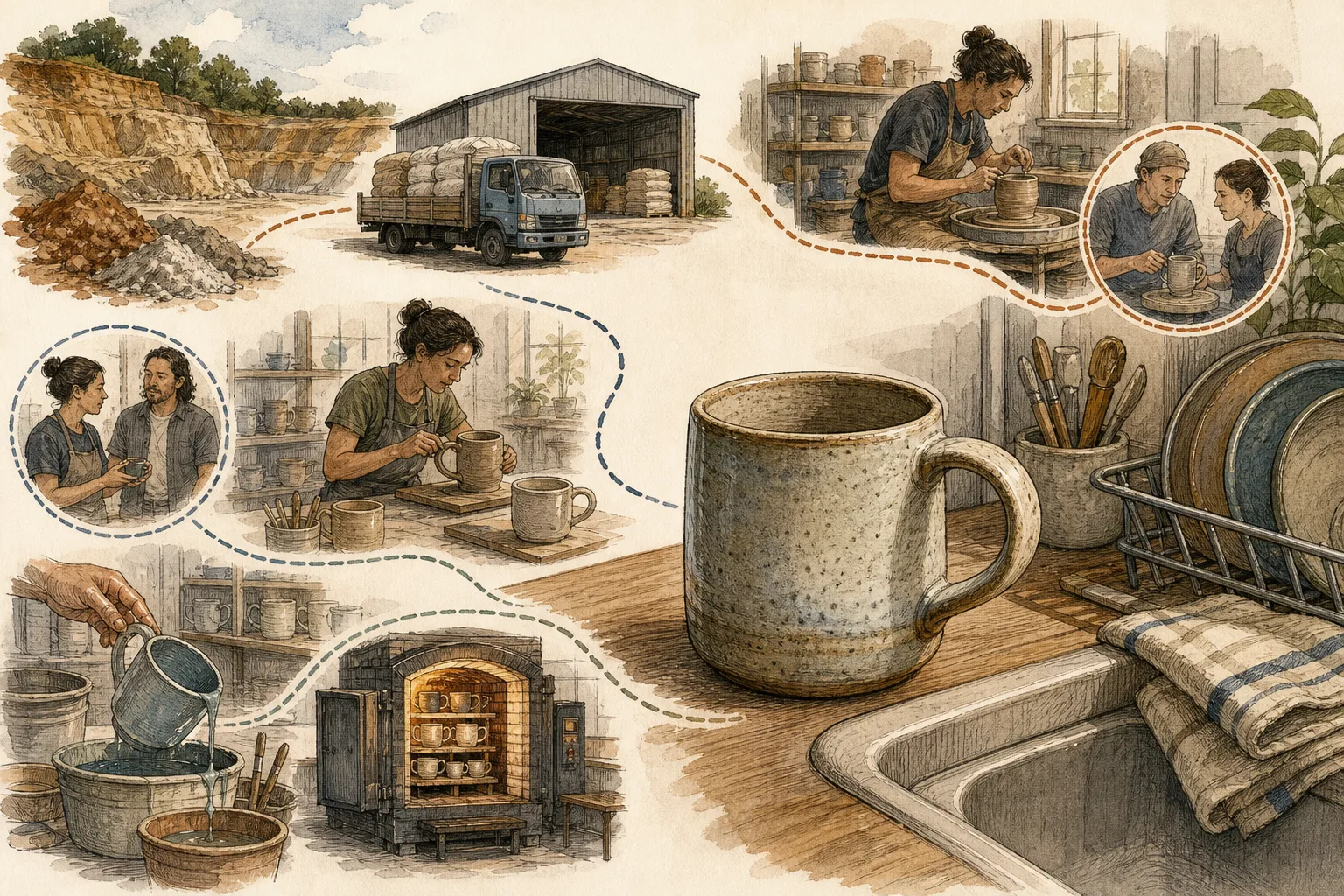
A ceramic mug sits beside the sink, its handle turned toward the dish rack. The route behind it may include a clay supplier, a potter’s workshop, and knowledge learned from someone elsewhere. Tracing a ceramic mug’s route is less about finding one tidy origin than understanding what each place contributed.
Where does the mug’s clay come from?
Start with the maker’s description rather than the mug’s color. Clay may come from a nearby source, a regional supplier, or a blend assembled from materials with different origins. The finished surface does not reliably distinguish among those possibilities.
When a listing says “local clay,” check what local means in that context. It could refer to where the material was extracted, prepared, or purchased; those are separate points in its route.
Clay and firing choices influence the forms a maker can produce, but the result depends on the particular material and workshop process. Without specialist documentation, a buyer should treat broad claims about composition or kiln behavior as claims to clarify, not technical conclusions to draw from appearance.
How do mug shapes and techniques travel?
A cylindrical body and curved handle answer familiar needs: holding a drink and lifting the vessel. Their familiarity does not assign them to one place. Forms and techniques move through teaching, trade, migration, workshops, and observation.
Imagine a small studio that buys clay from a regional supplier and teaches an apprentice a handle-making method learned from a visiting potter. The apprentice adjusts the curve to suit the studio’s thicker-walled forms; the observable result is a mug with a familiar outline and a different balance in the hand.
Design knowledge travels through people as well as objects. A maker may adapt a form seen elsewhere, learn a method from a teacher, or alter a familiar shape for the tools and materials available in the workshop.
What does “made in” tell you?
A mug may be formed in one place, glazed in another, and fired in a third. “Made in” can point to one stage or describe a broader production arrangement, so the phrase alone may not tell you who handled each part.
Making methods also vary. A potter may throw a mug on a wheel, press it into a mold, or build it by hand. Drying, glazing, and firing involve choices that depend on the maker’s materials and practice; a description that names the stages is more informative than one that simply says “handmade.”
Glaze and firing claims are especially hard to assess from a product page. If those details matter to your question, ask the maker or seller for the specific information they can provide rather than inferring a process from a photograph.
How can you trace a ceramic mug’s route?
Use the description as a set of separate claims, not as a complete map. For each detail, note what it identifies and what decision follows if it is clear or remains vague.
- Maker or brand: Check whether the name identifies a person, studio, or company. If it identifies the presenter but not the maker, ask who performed the work; if no answer is available, record that gap rather than treating the name as proof of production.
- Place of forming: Check whether the description names where the body was shaped. If it does, keep that location distinct from material origin; if it does not, ask where forming occurred or leave that stage unknown.
- Clay origin: Check whether “local” or “regional” is explained. If extraction or processing is specified, note which one; if neither is specified, treat the material’s route as unresolved.
- Glazing and firing: Check whether the seller names where those stages happened. If only the finishing location is given, do not assume the earlier work took place there; ask for the other stages or mark them unknown.
- Design credit: Check for a named designer, teacher, or workshop. If a source of the technique is identified, note that knowledge connection; if not, avoid assigning the design to a particular place.
- Meaning of “handmade”: Check which stage the word describes. If the listing explains the work done by hand, use that specific description; if it does not, ask what the term covers and do not infer that every stage happened in one workshop.
Say you are considering a mug whose listing names a studio, says “regional clay,” and identifies the place of final firing, but says nothing about where the body was shaped. Write down those three starting details, then ask the seller where shaping took place and whether “regional” refers to extraction or processing. If the seller confirms that the clay was processed nearby and the body was shaped at the named studio, record those answers while leaving the extraction site unresolved; if the seller cannot clarify, keep both points open rather than filling them in from the mug’s appearance.
Missing details do not prove deception, and a polished origin story does not account for every stage. A focused question can still produce useful partial information.
What do people ask about a ceramic mug’s origin?
Does “handmade” mean every stage happened in one place?
No. The word describes a method of work, but a listing may not specify which stages were done by hand or where they happened. Check for separate details about forming, glazing, firing, and materials.
Can you identify a mug’s clay by looking at it?
Appearance alone is not a dependable way to establish where the clay came from. A maker’s account may clarify the source or processing location; if it does not, treat the origin as unknown.
Why might a mug resemble one made elsewhere?
Similar forms can travel through teaching and trade, or develop as makers respond to familiar uses. A resemblance alone does not establish a direct link between particular workshops.
How is material origin different from place of manufacture?
Material origin concerns where an ingredient came from or was processed, while manufacture concerns where work on the object took place. A mug can have several relevant locations, each tied to a different stage.
What connections does a mug make visible?
A mug can connect material sources, learned techniques, workshop decisions, and daily use. The useful account is not necessarily the one with the most complete-sounding story, but the one that distinguishes confirmed stages from open questions.
When tracing a ceramic mug’s route, keep a simple record of each place and what happened there. That small distinction makes it easier to see how knowledge and materials connect people without asking one label to explain the whole object.
Keep exploring

How to Read Shared River Names on Maps
Learn how to read shared river names on maps by checking each label’s source, language, and…

The Border That Moves Without Moving
See how a border can stay fixed while rules, routes, and access change, and learn to…